
Top 10 Kraft Paper Tape Laminating Machine Manufacturers
Choosing the right Kraft Paper Tape Laminating Machine is rarely a simple price comparison. It is a production decision involving coating stability, web tension, drying performance, and long-term service.
In a converting plant, small details quickly become expensive. A drifting paper web can create uneven edges. Excessive heat may weaken the adhesive layer. A poorly designed rewinding unit can leave loose rolls, wrinkles, or telescoping. These problems may not appear during a short demonstration.
Packaging-converting consultant David Zwang offers a practical principle: “Consistency is the foundation of profitable converting.” That principle guides this review of the Top 10 Kraft Paper Tape Laminating Machine Manufacturers. Each manufacturer is considered through measurable factors, including machine structure, lamination accuracy, speed control, energy use, maintenance access, and technical support.
The strongest suppliers usually provide more than impressive specifications. They discuss paper grammage, adhesive chemistry, roll diameter, line speed, and factory conditions. That is important. A machine rated for high speed may perform differently with recycled kraft paper or sensitive water-based adhesive.
This ranking is not perfect. Manufacturer data can be selective, and customer results may vary by configuration. Some companies also publish limited information about lifetime operating costs. Readers should request sample trials, service records, and clear warranty terms before purchasing.
The goal is practical guidance, not a polished sales list. These manufacturers deserve attention because their equipment addresses real converting challenges. Still, every factory should test the machine against its own tape width, paper quality, adhesive system, and production targets.
What Kraft Paper Tape Laminating Machines Are and How They Work
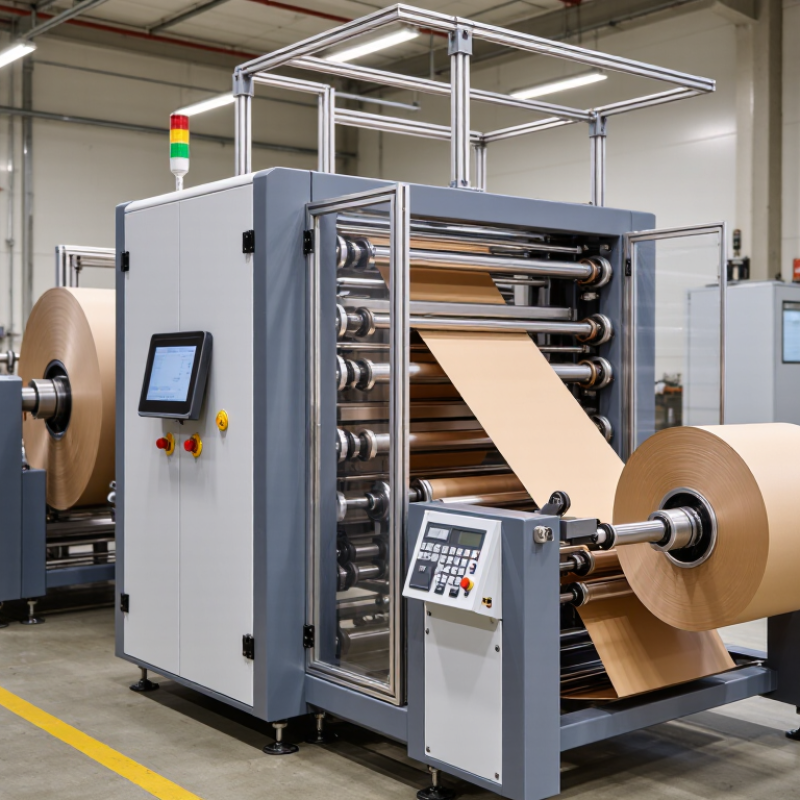
A kraft paper tape laminating machine bonds kraft paper to another functional layer, such as tissue, film, or reinforcement. It creates a stronger, more useful tape structure. In a typical production line, an unwinding unit feeds the paper at controlled tension. A coating head applies adhesive across the surface. The machine then brings the second web into contact through heated or rubber-coated nip rollers.
Pressure removes trapped air and helps the layers bond evenly. Depending on the adhesive, a drying oven, infrared section, or cooling zone follows the laminating station. Operators adjust line speed, coating weight, roller pressure, and temperature. Small changes matter. Excess adhesive can cause blocking, while low pressure may create bubbles or weak edges. Slitting knives later divide the wide laminate into narrow tape rolls.
From practical production checks, moisture control is often underestimated. Kraft paper can stretch when it absorbs humidity, changing roll alignment and final dimensions. Technicians should inspect peel strength, tensile strength, surface appearance, and unwind behavior from each batch. A simple visual check can reveal wrinkles, pinholes, or uneven coating. Results are not always perfect. An experienced operator may slow the line before increasing heat, because more heat can distort the paper. Regular cleaning also prevents dried adhesive from marking the rollers. Proper calibration, documented settings, and sample testing make the machine more reliable for daily tape production.
Key Features Used to Evaluate Kraft Paper Tape Laminating Machines
Top 10 Kraft Paper Tape Laminating Machine Manufacturers
Key Features Used to Evaluate Kraft Paper Tape Laminating Machines
Choosing among the top 10 manufacturers requires more than comparing catalog speed. Grand View Research valued the global adhesive tapes market at approximately USD 84.1 billion in 2023, with continued growth expected through 2030. That pressure increases the need for stable, repeatable lamination. Check actual output, not only advertised speed. A practical machine should maintain web tension across narrow rolls, prevent wrinkles, and keep adhesive coverage consistent near the edges.
Core evaluation points include coating accuracy, roller pressure, drying control, and automatic alignment. Test runs should measure coating weight, peel strength, splice quality, and waste percentage. A reliable control system records these values for later review. Energy use also matters. The U.S. Department of Energy reports that compressed-air systems can represent 10% to 30% of industrial electricity consumption, so pneumatic losses deserve attention. Small leaks become expensive.
Maintenance reveals the real difference.
Inspect accessible rollers, scraper systems, sensors, and adhesive lines. Operators should change components without lengthy stoppages. Safety guarding and emergency controls must be visible and easy to test. Smithers’ packaging research continues to highlight demand for recyclable, paper-based formats, but sustainability claims can be incomplete. A machine may process kraft paper efficiently while consuming excessive heat or producing high trim waste. I would request a full shift trial, including start-up losses and speed changes. The first sample often looks excellent; the tenth roll tells the truth.
Top 10 Kraft Paper Tape Laminating Machine Manufacturers
The top 10 kraft paper tape laminating machine manufacturers are usually judged by process control, not catalogue size. Leading suppliers typically offer machines with 600–1,600 mm working widths, servo-driven tension systems, and line speeds above 150 m/min. These specifications support stable bonding across recycled kraft paper, tissue, and reinforced tape structures.
According to Smithers’ packaging outlook, global paper-based packaging demand is expected to grow at roughly 3% annually through 2028. Grand View Research also reports continued expansion in sustainable packaging, although estimates vary by region and product definition. This difference matters. A serious manufacturer should explain its data, not hide behind optimistic forecasts.
Energy use deserves closer attention. Heating zones, drying efficiency, and motor control can strongly affect operating costs during long production runs. The strongest manufacturers provide trial-lamination support, tension calibration, spare-parts planning, and operator training. Ask for measured waste rates, adhesive compatibility results, and maintenance intervals. Speed is not everything. A machine running at 180 m/min may still lose money if edge curl, wrinkles, or uneven coating creates frequent rejects. In my view, rankings should include after-sales response time and real factory references. That information is sometimes incomplete, and buyers should remain skeptical. A polished demonstration is useful, but it cannot replace several hours of testing with the customer’s actual kraft paper and adhesive.
Top 10 Kraft Paper Tape Laminating Machine Manufacturers — Industry Specification Benchmark
This anonymous benchmark summarizes commonly published commercial specification ranges for kraft paper tape laminating equipment. Values are normalized to a 0–100 index so different units can be compared without displaying company or brand data.
Reference ranges used: production speed 80–250 m/min, working width 500–1600 mm, adhesive coating weight 5–30 g/m², unwind diameter 800–1200 mm, and rewind diameter 800–1200 mm. Actual specifications vary by machine configuration and application.
Comparing Manufacturer Capabilities, Applications, and Production Standards
Top 10 Kraft Paper Tape Laminating Machine Manufacturers
Comparing manufacturers requires more than reading speed claims. Smithers’ The Future of Packaging to 2028 estimates the global packaging market will approach 1.2 trillion dollars by 2028. This growth increases pressure on laminating lines, especially for stable output, lower waste, and repeatable adhesive coverage.
A capable manufacturer should show tested line performance. Look for web-width options, tension control, curing systems, and automatic roll changes. Kraft paper tape may serve carton sealing, splicing, masking, or reinforced packaging. Each application needs different coating weight, drying time, and winding accuracy. A machine for narrow tape cannot automatically handle heavy-duty reinforced grades.
Production Standards
Production standards reveal more than attractive brochures. ISO 9001 supports documented quality control, while ISO 14001 indicates structured environmental management. Buyers should request coating-weight records, peel-strength results, energy readings, and factory acceptance protocols. ASTM D3330 methods can help evaluate adhesive peel performance. CEPI reported an 82% paper recycling rate in Europe in 2022, increasing interest in recyclable paper-based formats.
Real Experience
Real experience still matters. Ask whether technicians have commissioned similar lines under dusty kraft-paper conditions. Check spare-part availability and remote diagnostic response times.
Published throughput can be optimistic. It sometimes excludes setup losses, rejects, and cleaning intervals. A pilot trial with actual kraft paper and adhesive is safer than relying on a demonstration reel. Production data should be independently reviewed.
How to Choose the Right Manufacturer for Your Business Needs
Top 10 Kraft Paper Tape Laminating Machine Manufacturers
Choosing among the top 10 manufacturers requires more than comparing machine prices. Smithers forecasts the global paper packaging market will exceed 500 billion dollars by 2028. This growth increases pressure for stable output and shorter delivery times. Ask each manufacturer for verified data on coating speed, lamination accuracy, waste rates, and energy use. Request a live trial using your kraft paper, adhesive, and release liner. A polished showroom sample can hide production problems.
Check engineering depth carefully. The machine should control web tension, drying temperature, adhesive thickness, and edge alignment. Small errors may create wrinkles, weak bonding, or uneven tape rolls. Request records from similar installations, including uptime and maintenance frequency. Suppliers with ISO 9001 certification usually provide stronger process controls, but certification alone proves little. Review their corrective-action records and spare-parts response time.
Energy deserves attention. The International Energy Agency reports that industry remains a major global energy consumer, making efficient dryers increasingly important. Compare kilowatt-hours per finished roll, not only motor ratings. Also examine software support, operator training, safety guarding, and remote diagnostics. A cheaper machine may become expensive after repeated stoppages. I would leave room for doubt here: quoted capacity often reflects ideal conditions, not daily production. An honest manufacturer should explain those limits clearly. Choose the partner that demonstrates repeatable results, transparent testing, and practical after-sales support.
| Rank | Manufacturer Profile | Primary Production Region | Typical Machine Configuration | Compatible Kraft Tape Structure | Typical Working Speed | Usable Web Width | Adhesive Compatibility | Automation Level | Quality and Safety Features | Best Fit for Buyers | Selection Score |
|---|---|---|---|---|---|---|---|---|---|---|---|
| 1 | Profile A High-speed specialist | East Asia | Multi-roll laminator with automatic tension control, edge alignment and turret rewinding | Single-sided reinforced kraft tape, fiberglass-reinforced tape and flat kraft tape | Up to 180 m/min | 1,300–1,600 mm | Water-based starch, dextrin, synthetic and pressure-sensitive adhesives | Advanced PLC with touchscreen HMI and recipe storage | Load-cell tension control, web inspection option, emergency guarding and automatic splicing | Large converters requiring high output and repeatable roll quality | 9.4 / 10 |
| 2 | Profile B Flexible production | Western Europe | Modular laminating line with interchangeable coating, drying and slitting sections | Plain kraft tape, reinforced gummed tape and printable paper tape | Up to 150 m/min | 1,000–1,500 mm | Water-based and hot-melt adhesive systems | Servo-driven controls with automatic recipe adjustment | Closed-loop drying control, solvent-free configuration and CE-oriented guarding | Businesses needing multiple products on one production platform | 9.2 / 10 |
| 3 | Profile C Heavy-duty line builder | East Asia | Heavy-frame laminator designed for thicker paper, reinforcement yarn and abrasive substrates | Water-activated reinforced kraft tape and industrial packaging tape | Up to 120 m/min | 1,300–1,800 mm | Starch, dextrin and water-based synthetic adhesives | PLC control with semi-automatic roll handling | High-torque drive system, pneumatic pressure adjustment and reinforced roller assemblies | Industrial tape producers prioritizing durability over maximum speed | 9.0 / 10 |
| 4 | Profile D Compact equipment | South Asia | Compact laminating, drying and slitting machine for narrow and medium-width rolls | Paper masking tape, kraft carton-sealing tape and lightweight reinforced tape | Up to 90 m/min | 600–1,200 mm | Water-based and acrylic adhesive systems | Digital speed control with manual setup assistance | Basic tension control, temperature monitoring and accessible maintenance points | Start-ups, regional converters and facilities with limited floor space | 8.6 / 10 |
| 5 | Profile E Custom-engineering focus | Western Europe | Engineered-to-order line with customized coating, lamination and die-cutting modules | Decorative kraft tape, printed paper tape and specialty composite tape | Up to 110 m/min | 800–1,400 mm | Water-based, hot-melt and selected solvent-free systems | High automation with integrated production monitoring | Inline thickness measurement, programmable drying zones and traceable process data | Specialty manufacturers with demanding product specifications | 8.9 / 10 |
| 6 | Profile F Cost-effective solution | East Asia | Standard two-roll or three-roll laminator with independent slitting and rewinding | General-purpose kraft packaging tape and paper adhesive tape | Up to 100 m/min | 800–1,300 mm | Water-based starch, dextrin and acrylic adhesives | PLC-based control with optional automatic functions | Basic web guiding, temperature control and overload protection | Small and medium-sized manufacturers focused on capital efficiency | 8.4 / 10 |
| 7 | Profile G Sustainable production | Northern Europe | Low-energy laminating and drying system optimized for water-based adhesive processing | Recyclable kraft tape, paper-based reinforced tape and plastic-free packaging tape | Up to 85 m/min | 700–1,300 mm | Water-based starch, dextrin and bio-based adhesive formulations | Automatic process control with energy monitoring | Heat recovery options, solvent-free operation and low-waste web handling | Eco-focused brands and converters targeting recyclable packaging markets | 8.7 / 10 |
| 8 | Profile H Regional service network | North America | Integrated laminator with serviceable coating head, slitter and automatic roll unloading | Industrial kraft tape, carton sealing tape and reinforced paper tape | Up to 100 m/min | 900–1,500 mm | Water-based, acrylic and hot-melt adhesive systems | PLC and servo controls with remote diagnostic capability | Guard interlocks, digital fault logging and preventive-maintenance alerts | Buyers that value local technical support and short response times | 8.8 / 10 |
| 9 | Profile I Printing integration | East Asia | Laminating line integrated with flexographic printing, drying, slitting and rewinding | Branded paper tape, printed kraft tape and multi-layer packaging tape | Up to 80 m/min | 600–1,200 mm | Water-based inks, starch adhesives and acrylic adhesive systems | Centralized touchscreen control with registration adjustment | Print registration control, drying-temperature monitoring and automatic length counting | Converters producing customized or printed paper tape | 8.5 / 10 |
| 10 | Profile J Entry-level modular system | South Asia | Basic laminating and rewinding line with optional drying and slitting modules | Lightweight kraft tape, paper masking tape and general packaging tape | Up to 70 m/min | 500–1,000 mm | Water-based and pressure-sensitive adhesives | Manual setup with digital speed and temperature displays | Simple guarding, overload protection and replaceable wear components | New converters testing demand before investing in a larger line | 8.1 / 10 |
Article Source:
Submit a quote request or book a design consultation
Plastimold Products is an end-to-end product development and manufacturing team. We provide product design, engineering, prototyping, tooling, plastic injection molding, assembly, packaging and fulfillment. We work with any size company from start-ups to enterprises from all around the world.
I have a product I want to manufacture
I have a product that is already designed and now needs to be manufactured.
I need a manufacturer to optimize my product for injection molding, help choose the correct material, and manage the product production.
I have tooling that I want to transfer or modify, or I need to produce new tooling.
I need design and engineering support
I have a product concept that I want to be designed and brought to market.
I have a product that needs to be reviewed, improved or DFM’ed.
I am looking for a manufacturer to provide an end-to-end solution, from design and development to inventory, marketing, and sales.

©2022 Plastimold Products - Privacy policy - Terms and Conditions

