
10 Standing Mirror Wall Tips for Global Buyers
A Standing Mirror Wall can make a room feel brighter, taller, and more considered, but global buyers must look beyond appearance. Frame finish, glass clarity, mounting hardware, packaging, and shipping dimensions all affect the final result. A mirror that looks elegant in a showroom may arrive with a chipped edge or prove difficult to secure on a plaster wall. Small details matter.
Grand View Research estimated the global home décor market at USD 696.4 billion in 2023 and projected a 4.0% compound annual growth rate from 2024 to 2030. This broad market figure is not a mirror-specific forecast, but it signals a competitive category where product quality and clear specifications can help buyers make informed choices. Interior designer Nate Berkus has said, “Your home should tell the story of who you are, and be a collection of what you love.” His advice is not specifically about mirrors, yet it offers a useful design lens: a full-length mirror should suit both the room and the person using it.
The following ten tips focus on practical decisions, from measuring wall clearance to checking mirror safety and confirming export packaging. Compare dimensions, installation instructions, and supplier claims before placing an order. A polished product photo is not enough. Some questions will remain. That is worth admitting. A careful checklist cannot prevent every breakage or mismatch, but it can reduce avoidable surprises.
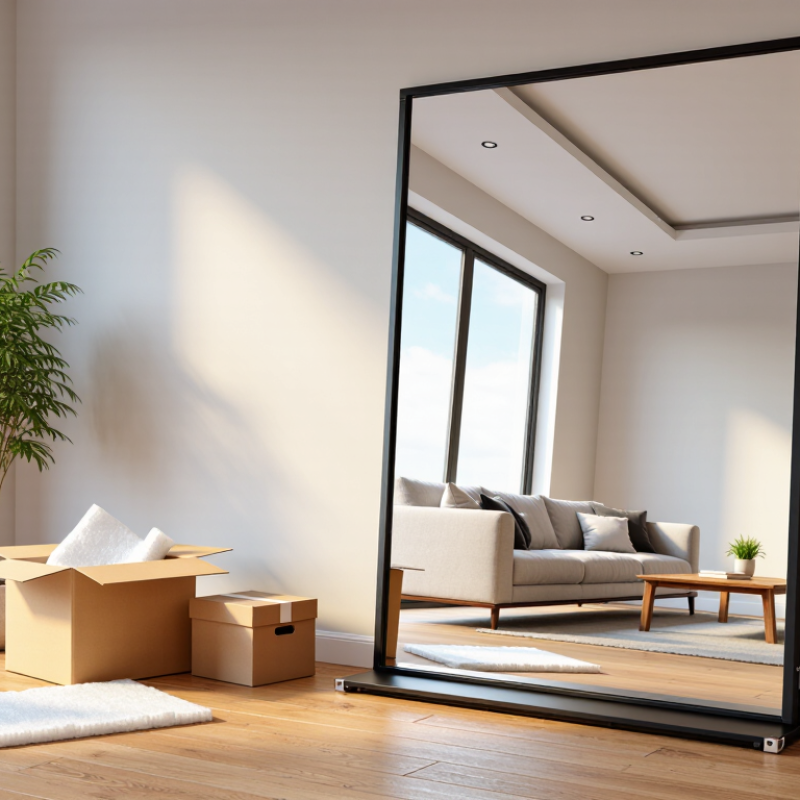
Understanding Standing Mirrors and Their Wall-Mounting Options
A standing mirror is usually a tall mirror designed to rest on the floor, often with a rear support or angled frame. Some models can also lean against a wall. That does not automatically make them suitable for wall mounting. Check the product’s mounting instructions, weight, and frame construction before choosing an installation method. A mirror with a folding support, for example, may need different hardware from one built with fixed mounting points.
Wall-mounting options generally include hanging the mirror from purpose-made brackets, securing it through a reinforced frame, or using a cleat system that distributes weight across a wider area. The right choice depends on the wall surface and the mirror’s design. Plasterboard, masonry, and timber walls need different fixings. A small test measurement helps. Locate studs where possible, and use anchors rated for the mirror’s weight. Keep the lower edge clear of skirting boards and nearby furniture so the glass sits flat.
For global buyers, ask whether mounting hardware is included and whether instructions specify wall types. Packaging may contain screws that suit one surface but not another. That detail is easy to overlook. Measure the mirror, available wall space, and doorway before delivery; a tall frame can be awkward to move through a narrow hall. If the frame has no rated mounting points, keep it floor-standing and use an approved anti-tip restraint instead. Even careful planning can miss a detail, so inspect the frame and fittings before installation.
Choosing the Right Size, Shape, and Placement for Your Space
A standing mirror should show your full outline without forcing you to step across the room. Measure the tallest user, then check the mirror’s visible height and the distance needed to stand back. A narrow hallway may suit a slim rectangle; a rounded top can soften a room with sharp furniture edges. Check the frame width, too. It can hide useful reflective area. A little awkward, but easy to miss.
Placement changes both comfort and the mirror’s usefulness. Set it near natural light, but angle it away from direct sun and bright lamps to reduce glare. Leave enough clearance for doors, drawers, and walking paths.
For an accessibility reference, the 2010 ADA Standards for Accessible Design, Section 603.3, specify a mirror’s lower reflective edge at no more than 40 inches above the floor or counter, with its upper edge at least 74 inches high. This is a useful benchmark, not a universal rule for every freestanding mirror. Check local access guidance and the actual users’ reach.
Before fixing a position, test it with a paper outline. It may look right on screen and feel wrong in the room.
Comparing Frames, Materials, and Stability Features
When comparing standing mirrors, start with the frame, not just its finish. Solid wood can feel substantial, but its weight may raise shipping costs and make repositioning harder. Steel frames are often slimmer and resist everyday knocks, though thin sections can flex. Check corner joints and rear supports closely. A smooth coating matters too, especially in humid rooms where exposed edges may wear sooner.
Glass thickness and backing affect both weight and handling. Ask suppliers for measured specifications rather than relying on words like “premium.” Small details matter. For wall-leaning designs, look for a broad floor contact and a secure anti-tip strap suited to the intended wall surface. A narrow base may wobble on uneven tile, even when the mirror looks sturdy in a showroom. Not every room is level. Check whether feet adjust, and confirm that mounting hardware is included or clearly listed as an extra. Packaging deserves attention: protected corners and a rigid outer carton can reduce transit damage, but no package is foolproof. I would compare sample units when possible; product photos rarely reveal how a frame feels when moved. A slightly imperfect finish may be acceptable, but loose joints or unclear stability instructions deserve another look.
10 Standing Mirror Wall Tips for Global Buyers - Comparing Frames, Materials, and Stability Features
| # | Buying Tip | Frame or Material Comparison | Stability Feature to Check | Practical Check |
|---|---|---|---|---|
| 1 | Choose the frame for the room conditions. | Solid wood offers a natural look; metal frames are often slim and rigid. MDF and other engineered-wood frames can be more vulnerable to moisture damage if their edges or finish are not well sealed. | Look for a frame that stays rigid when the mirror is moved and has no loose joints. | For humid rooms, check the maker’s care guidance and avoid assuming that any wood-based frame is moisture-proof. |
| 2 | Compare metal types and finishes. | Aluminum is relatively lightweight and naturally forms a protective oxide layer; steel is generally heavier and strong. Either material can be affected by corrosion in unsuitable conditions or with damaged finishes. | Check that corner joints are secure and the finish is continuous, especially around edges and fasteners. | For coastal or damp locations, ask about the metal grade, coating, and recommended cleaning routine. |
| 3 | Match the base to the mirror’s height. | A tall, narrow mirror has a higher center of gravity than a shorter, broader design, so its stand and support arrangement matter. | A broad, well-supported base or a properly fitted wall restraint can reduce the risk of tipping. | Check the assembled footprint and follow the manufacturer’s instructions for the intended standing angle. |
| 4 | Look for an anti-tip restraint. | Frame material alone does not prevent a mirror from tipping. A secure connection to a suitable wall structure provides an additional restraint. | Check whether the mirror includes a strap or bracket and whether the fasteners suit the wall type. | Use appropriate fixings for the wall and install the restraint as directed; do not rely on adhesive alone for a heavy mirror. |
| 5 | Inspect hinges, braces, and joints. | Folding or cheval-style mirrors depend on moving joints; fixed-frame designs have fewer moving parts but still need sound connections. | Hinges should move smoothly without excessive looseness, and braces should lock or seat securely in their intended position. | Ask how the mirror is assembled and whether replacement hardware is available in the destination market. |
| 6 | Check the floor-contact points. | Hard feet may slide or mark some floors, while suitable pads can improve grip and help protect the surface. | Look for stable, even contact points and non-slip pads that do not rock on a level floor. | Confirm that the feet suit the floor surface and can be replaced if worn. |
| 7 | Ask about mirror-glass safety. | Ordinary mirror glass can break into sharp pieces. Safety backing may help retain fragments, but it does not make glass unbreakable. | A secure glass-to-frame fit helps prevent the mirror panel from shifting within the frame. | Check the product’s glass and backing specifications, and handle and install the mirror according to its instructions. |
| 8 | Verify dimensions and weight before shipping. | Frame material, glass thickness, and overall size affect the mirror’s weight and the demands on the stand and wall restraint. | Ensure the stand, hardware, and intended wall fixings are rated or specified for the assembled product. | Compare packaged dimensions with doorways, lifts, and local delivery limits; request metric and imperial measurements if needed. |
| 9 | Consider replacement and repair options. | Wood, metal, and engineered-wood frames need different care. Availability of compatible hinges, feet, or mounting hardware can vary by market. | Replace damaged supports or restraints before continued use rather than relying on a weakened joint. | Ask for care instructions and a parts list, and confirm how to obtain suitable replacement components locally. |
| 10 | Review the full installation instructions. | Different designs may be intended to stand freely, lean against a wall, or use both a floor support and wall restraint. | Use the mirror only in its specified configuration; do not remove a supplied brace or restraint to change its setup. | Check that instructions are clear, hardware is included, and the installation method is suitable for the intended room and wall. |
Checking Safety Standards and Packaging for International Shipping
Before ordering a standing mirror for wall installation, request glass specifications and test documents. Tempered glass may meet EN 12150, while laminated glass is covered by the EN ISO 12543 series. These standards address glass performance, not the complete mirror, frame, or mounting system. Ask for evidence covering the assembled product and its intended installation. Small distinctions matter.
Shipping deserves equal scrutiny. UNCTAD’s Review of Maritime Transport 2024 reports that more than 80% of world trade by volume moves by sea. Long transit times and repeated handling make edge protection essential. Ask whether the export pack has been tested against an appropriate ISTA procedure, such as ISTA 3E for unitized loads. Request photos of corner blocks, a rigid backer, moisture protection, and pallet restraint. Foam alone is not enough.
Before shipment, confirm the crate dimensions, gross weight, and unpacking instructions. Check that the mirror cannot shift inside its frame, and that fragile edges do not touch the crate. Ask the supplier to photograph the packed unit and record any inspection results. Packaging plans are rarely perfect; a trial shipment may reveal weak corners or awkward handling points. That feedback is useful.
Standing Mirror Shipping: ISTA 1A Drop-Test Heights
ISTA 1A specifies different drop heights according to the gross weight of the packaged product. These values apply to packaged products weighing up to 150 lb (68 kg); they are test conditions, not a guarantee against shipping damage.
For international shipments, confirm the current ISTA procedure and any destination-market glass-safety requirements. A package test does not replace applicable product safety compliance. Source: International Safe Transit Association (ISTA).
Evaluating Suppliers, Customization, and Total Purchase Costs
For a standing mirror, compare suppliers by documented capability, not polished product photos. Request a dated specification covering glass thickness, frame material, dimensions, backing, and packaging. Ask for a pre-production sample and written tolerances for color and size. Small differences matter when mirrors are installed side by side. UNCTAD’s Review of Maritime Transport 2024 reports that over 80% of world trade by volume moves by sea, making packaging and freight planning central to landed cost.
Customization can add value, but every change needs a price and lead-time impact. Confirm whether custom heights, frame finishes, wall-fixing hardware, or private-label cartons require minimum order quantities. Ask how the supplier tests corner protection and handles transit damage. The World Bank’s 2023 Logistics Performance Index assessed 139 economies across areas including customs, infrastructure, and timeliness; use it to compare shipping environments, not as proof of a supplier’s quality.
Calculate total purchase cost per sellable mirror: unit price, sample fees, tooling, packaging, freight, insurance, duties, and expected breakage. Request quotes using the same delivery terms and destination, or the comparison can mislead. Check carton dimensions too; bulky mirror shipments may incur volume-based charges. Leave room for uncertainty. A sample can look perfect, yet a full production run may vary. Include a small inspection allowance in the budget.
Article Source:
Submit a quote request or book a design consultation
Plastimold Products is an end-to-end product development and manufacturing team. We provide product design, engineering, prototyping, tooling, plastic injection molding, assembly, packaging and fulfillment. We work with any size company from start-ups to enterprises from all around the world.
I have a product I want to manufacture
I have a product that is already designed and now needs to be manufactured.
I need a manufacturer to optimize my product for injection molding, help choose the correct material, and manage the product production.
I have tooling that I want to transfer or modify, or I need to produce new tooling.
I need design and engineering support
I have a product concept that I want to be designed and brought to market.
I have a product that needs to be reviewed, improved or DFM’ed.
I am looking for a manufacturer to provide an end-to-end solution, from design and development to inventory, marketing, and sales.

©2022 Plastimold Products - Privacy policy - Terms and Conditions

