
How to Choose a Coil Transfer Cart in 2026?
Choosing a Coil Transfer Cart in 2026 starts with the coil, the route, and the real working conditions. World Steel Association’s World Steel in Figures 2025 reports global crude steel production of 1,882.6 million tonnes in 2024. That scale reflects a demanding industrial environment. It does not, by itself, determine which cart a plant needs.
A practical selection begins with coil weight, diameter, width, and the shape of the supporting saddle. Measure the narrowest aisle and check floor joints, slopes, turning space, and stopping points. Then compare load capacity, travel speed, braking, steering, power supply, and control options. A cart that carries the rated load may still struggle with frequent starts or uneven flooring. Small details matter. So does the route after a shift change.
Review the duty cycle and charging or battery-change plan before comparing purchase prices. Ask suppliers for documented load tests, maintenance intervals, spare-parts availability, and site-specific references. Confirm that the cart’s dimensions suit the actual coil—not an idealized drawing. A remote-control feature may help visibility, but it cannot fix a poor turning radius. That is easy to overlook.
This guide explains how to match a Coil Transfer Cart to production needs, safety procedures, and operating costs. Some specifications look convincing on paper. The better choice is the one that works reliably on your floor, with your coils, every day. And reassess the assumptions: plant layouts change.
Understand the Role and Operating Conditions of a Coil Transfer Cart
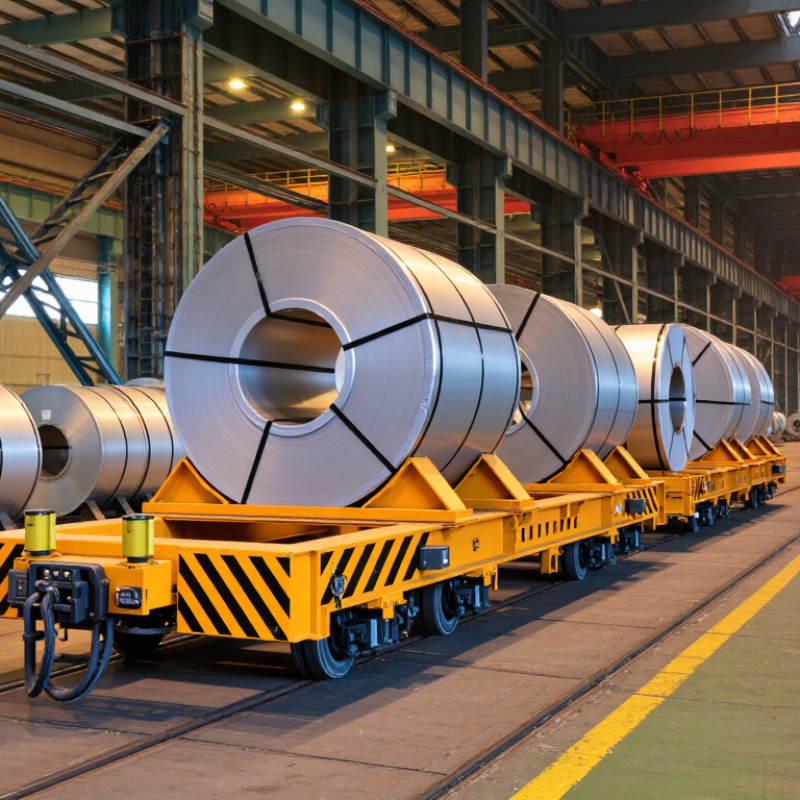
A coil transfer cart moves heavy, rolled material between storage, processing, and loading areas. Its role is to carry the coil securely while keeping movement controlled along a defined route. In a stamping plant, that route may pass beside presses, through narrow aisles, or across floor joints. The cradle must match the coil’s diameter, width, and orientation.
That detail matters.
A cart designed around rated weight alone may still handle poorly if the coil sits off-center or shifts during travel.
Start with real operating conditions, not an ideal layout. Record the heaviest coil, the typical load, travel distance, and trips per shift. Measure aisle width and turning space with nearby equipment in place. Floor slope, cracks, debris, and wet areas can affect traction and stability. Consider whether the cart runs continuously or only a few times each day; these patterns place different demands on its drive and power system. Check loading height and transfer points, too. A small mismatch can slow every handoff. Teams sometimes overlook operator sightlines, especially when a large coil blocks forward visibility. Even a well-matched cart may feel cumbersome on a crowded route, so trialing the actual path can reveal details that drawings miss.
Define Coil Dimensions, Load Capacity, and Handling Requirements
How to Choose a Coil Transfer Cart in 2026?
Define Coil Dimensions, Load Capacity, and Handling Requirements
Start with the coil, not the cart. Record its maximum weight, outside diameter, inside diameter, width, and any variation between batches. A wide coil can sit differently from a narrow one, even at the same weight. Check how the cradle supports the coil, where its center of gravity falls, and whether the coil can shift during travel. Small details matter. World Steel Association’s World Steel in Figures 2024 reports 1,892.2 million tonnes of crude steel production worldwide in 2023. That scale makes repeatable handling important, but it does not tell you your site’s required payload.
Set capacity using the heaviest expected coil, plus the cart’s own load conditions and any attachments. Ask an engineer to verify the design margin; do not treat a convenient capacity figure as a universal safety rule. The IEA’s Iron and Steel Technology Roadmap (2020) estimates direct steel-sector emissions at about 2.6 gigatonnes of CO2 annually, underlining the industry’s scale—not a cart-sizing formula. Measure the actual route: floor joints, ramps, tight turns, transfer gaps, and stopping points.
Specify how the cart will be loaded and unloaded, and whether operators need precise positioning. A drawing can miss a worn floor plate or a slightly off-center coil. That happens. Test the proposed cradle and travel path with real dimensions, then revisit assumptions when coil specifications or production routines change.
Choose the Power Supply, Drive System, and Control Method
In 2026, match a coil transfer cart’s power supply to the shift pattern, not just the shortest route. A battery-powered cart suits flexible paths and avoids trailing cables, but confirm runtime with the heaviest coil and allow time for charging. A cable reel or conductor rail can support long, repetitive runs. Check cable travel, aisle crossings, and dust around charging points. Small details matter. Record trips per hour and minutes spent waiting; estimates from a quiet day can mislead.
The drive system must move the rated load without wheel slip or harsh starts. Geared motors with controlled acceleration help protect the coil and reduce load shifts. Review floor joints, gradients, turning radius, and wheel loading with the equipment supplier. A smooth floor can still have a troublesome seam. Verify braking distance with a loaded cart, not an empty one. If routes change often, service access and tire replacement may matter more than peak speed.
Control choice depends on sight lines and operator workflow. A pendant is direct and simple, while radio control lets the operator stand clear of the travel path. Programmable controls can manage speed zones and stopping points, but should not replace clear alarms or accessible emergency stops. Test the system beside the real coil, with the operator in the actual working position. We may overlook this. The most automated setup is not always the best; review it after several weeks of production.
Evaluate Safety Features and Compatibility with the Worksite
How to Choose a Coil Transfer Cart in 2026?
Evaluate Safety Features and Compatibility with the Worksite
A coil transfer cart should match the coil’s weight, width, and handling method. Check rated capacity against the heaviest load, including the cradle or fixture. A shaped cradle helps keep a coil from shifting; confirm its dimensions suit your coil range. Look for accessible emergency stops, reliable braking, and clear warning signals. Small details matter. Ask how the cart behaves on your actual floor, not just a smooth test surface.
Tips: Measure aisle width, turning space, doorway clearance, and floor capacity before selecting a cart. Map the route, including slopes, joints, and busy crossings. Measure twice. Compare the required stopping distance with the available clear space, especially near workstations.
Power and controls also need to fit the worksite. A battery-powered cart may need a practical charging area and enough runtime for each shift. Check whether operators can see the travel path and reach controls while standing safely away from the coil. Confirm the cart can approach loading points without blocking other equipment. Specifications do not capture every awkward corner, so a supervised trial with a representative load can expose issues early. A trial may still miss peak-shift congestion; review the route with operators who use it daily.
Compare Technical Specifications, Maintenance Needs, and Supplier Support
Choosing a coil transfer cart in 2026 starts with the actual load, not just its rated capacity. Record coil weight, width, outside diameter, and bore size, then check how the load sits on the cradle. A cart rated for the right weight may still be unsuitable if its supports do not match the coil. Small details matter. Compare travel speed, turning radius, braking, and battery range against your route and shift length. Check floor joints, ramps, and clearance near presses or storage racks. Ask suppliers to explain how their figures were tested, especially for stopping distance and runtime under load.
Maintenance needs affect more than service costs; they can interrupt production. Compare access to wheels, drive components, batteries, and controls, and request a realistic inspection schedule. Ask which parts are routinely replaced and how quickly they can be supplied. A maintenance plan that assumes perfect conditions may look good on paper. It may not fit a dusty floor or frequent short trips. Supplier support deserves the same scrutiny as the specification sheet. Ask who handles commissioning, operator training, troubleshooting, and warranty claims. Ask for evidence. Clear answers, useful drawings, and a defined response process make it easier to judge support before a cart reaches the line.
Article Source:
Submit a quote request or book a design consultation
Plastimold Products is an end-to-end product development and manufacturing team. We provide product design, engineering, prototyping, tooling, plastic injection molding, assembly, packaging and fulfillment. We work with any size company from start-ups to enterprises from all around the world.
I have a product I want to manufacture
I have a product that is already designed and now needs to be manufactured.
I need a manufacturer to optimize my product for injection molding, help choose the correct material, and manage the product production.
I have tooling that I want to transfer or modify, or I need to produce new tooling.
I need design and engineering support
I have a product concept that I want to be designed and brought to market.
I have a product that needs to be reviewed, improved or DFM’ed.
I am looking for a manufacturer to provide an end-to-end solution, from design and development to inventory, marketing, and sales.

©2022 Plastimold Products - Privacy policy - Terms and Conditions

