
What Is EV Charger Type 2 and How Does It Work?
Ev Charger Type 2 is a common AC charging connector used across many electric vehicles and charging stations. It is also known as the Mennekes connector. Unlike a household plug, it is designed for controlled, safer vehicle charging. The connector typically supports single-phase and three-phase AC power. Charging speed depends on the vehicle, charger, cable, and electrical installation.
Inside the connector, several pins carry power and communication signals. The power pins deliver alternating current to the vehicle. The car’s onboard charger then converts that AC power into DC electricity for the battery. Control Pilot communication helps manage charging safely. Proximity Pilot detection helps confirm the cable connection. A typical home unit may deliver 7.4 kW on single-phase power. Some three-phase installations can reach 11 kW or 22 kW.
Real-world charging is rarely as simple as the label suggests. A 22 kW charger may still charge slowly if the vehicle accepts only 11 kW. Cable quality matters. So does the building’s wiring. At a public station, you may connect an untethered cable and wait for authorization. At home, a wall-mounted unit can make overnight charging feel routine. Small details matter.
This guide explains how Ev Charger Type 2 works, where it fits, and what users should check before installation. It also separates connector capability from actual charging performance. Standards and vehicle specifications can vary by market. Always verify the vehicle manual and charger documentation. That step is easy to skip. It can also prevent an expensive misunderstanding.
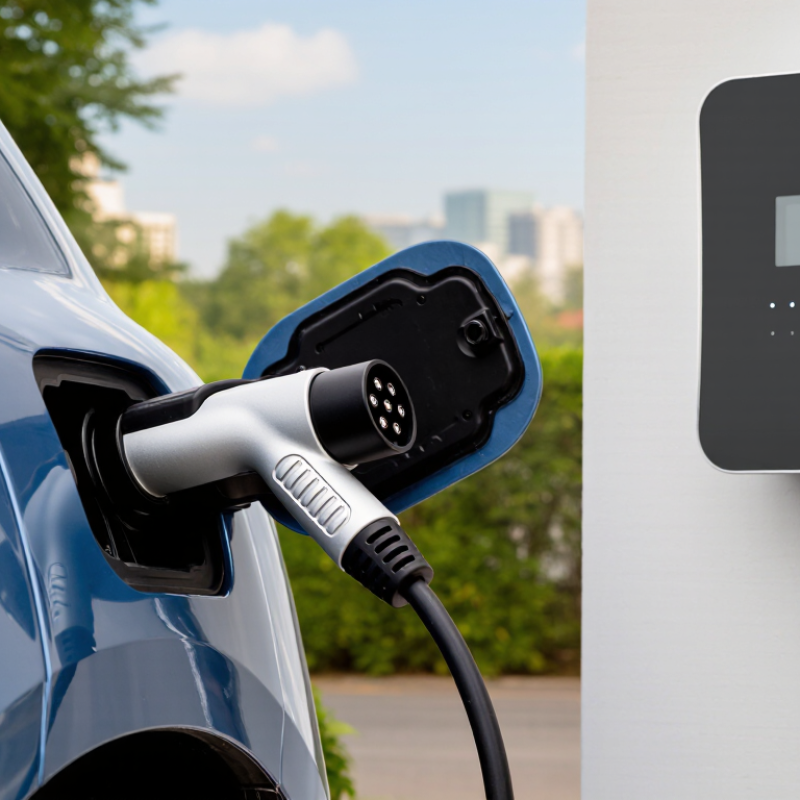
What Is an EV Charger Type 2?
An EV Charger Type 2 usually refers to an alternating-current (AC) charging connection used widely in Europe and other regions. It is more accurate to call it a Type 2 connector or inlet. The wall unit supplies electricity, while the vehicle’s onboard charger converts AC into battery-ready DC. That distinction matters when comparing charging speeds.
Type 2 connectors are standardized under IEC 62196-2. They typically have seven contacts: three for phases, one neutral, one protective earth, and two control contacts. The control pilot communicates charging readiness, allowable current, and connection status. A proximity contact helps detect the plug and supports safer disconnection. Depending on the installation, Type 2 charging may use single-phase or three-phase AC power. Output often ranges from about 3.7 kW to 22 kW, but the vehicle, cable, and electrical supply set the real limit.
A Type 2 connection does not automatically mean rapid charging. A vehicle limited to 7.4 kW will not accept 22 kW simply because the station offers it. Cable ratings and household wiring also deserve attention. Heat around a loose connection is a warning sign. In practical checks, inspect the pins, seals, locking action, and visible damage before charging. The terminology remains imperfect, and local regulations can change installation requirements. A qualified electrician should verify the circuit, protection, and earthing arrangement.
| Data Dimension | Typical Specification | How It Works or Why It Matters |
|---|---|---|
| Technical Name | IEC 62196-2 Type 2 | Type 2 is an electric vehicle charging connector standardized for conductive AC charging. It is commonly used on vehicles and charging equipment in Europe and many other markets. |
| Primary Charging Current | Alternating current (AC) | The vehicle's onboard charger converts incoming AC electricity into direct current (DC) to charge the battery. |
| Connector Contacts | 7 contacts | The connector has three phase contacts, a neutral contact, a protective earth contact, a control pilot contact, and a proximity pilot contact. |
| Common Voltage Range | Approximately 230–400 V AC | Single-phase installations generally use about 230 V, while three-phase installations commonly use about 400 V between phases. The actual supply depends on the local electrical system. |
| Single-Phase Charging | Typically up to 7.4 kW | At approximately 230 V and 32 A, single-phase charging can provide about 7.4 kW, provided that the vehicle and electrical installation support this level. |
| Three-Phase Charging | Typically up to 11 kW or 22 kW | At approximately 400 V, three-phase charging can provide about 11 kW at 16 A per phase or about 22 kW at 32 A per phase. The lower-rated component determines the actual charging power. |
| Maximum Current Rating | Commonly up to 32 A per phase | The connector, cable, charging station, vehicle inlet, and electrical circuit must all be rated for the selected current. Some installations may operate below this limit. |
| Charging Communication | Control Pilot and Proximity Pilot | The Control Pilot manages charging-state communication and helps identify available current. The Proximity Pilot detects the connected cable and supports safe disconnection behavior. |
| Typical Charging Mode | Mode 3 AC charging | A dedicated charging station controls the connection to the electrical supply and communicates with the vehicle before energizing the charging conductors. |
| Charging Speed | Dependent on power and battery capacity | Charging time is affected by charging power, battery size, battery state of charge, temperature, and the vehicle's onboard AC charger. A Type 2 connector alone does not guarantee a specific speed. |
| Safety Features | Interlocking and electrical protection | Charging equipment normally checks the connection and pilot signals before supplying power. The installation should also include suitable overcurrent and residual-current protection. |
| Cable Configuration | Tethered or detachable | A charging station may have a permanently attached cable, while another may provide a Type 2 socket that requires a separate Type 2 charging cable. |
| AC Charging Limitation | Limited by the onboard charger | If a vehicle's onboard charger accepts only 11 kW, connecting it to a 22 kW Type 2 charging station will not increase the vehicle's charging power beyond 11 kW. |
| Weather and Use Considerations | Designed for regular outdoor and indoor use | The connector and charging equipment should be installed and used according to their stated ingress-protection, temperature, cable, and maintenance requirements. |
Note: Actual charging performance varies by vehicle, charging station, cable, local voltage, circuit capacity, battery condition, and applicable electrical regulations.
Submit a quote request or book a design consultation
Plastimold Products is an end-to-end product development and manufacturing team. We provide product design, engineering, prototyping, tooling, plastic injection molding, assembly, packaging and fulfillment. We work with any size company from start-ups to enterprises from all around the world.
I have a product I want to manufacture
I have a product that is already designed and now needs to be manufactured.
I need a manufacturer to optimize my product for injection molding, help choose the correct material, and manage the product production.
I have tooling that I want to transfer or modify, or I need to produce new tooling.
I need design and engineering support
I have a product concept that I want to be designed and brought to market.
I have a product that needs to be reviewed, improved or DFM’ed.
I am looking for a manufacturer to provide an end-to-end solution, from design and development to inventory, marketing, and sales.

©2022 Plastimold Products - Privacy policy - Terms and Conditions