
What Are the Best DTF Transfer Film Rolls from China?

Choosing the best DTF Transfer Film Rolls (DTF Film) from China requires more than comparing prices. It requires practical testing, clear specifications, and careful supplier evaluation. The right film should support sharp edges, solid ink adhesion, smooth powder coverage, and dependable transfer results. These details matter when a printer handles cotton shirts, polyester garments, or blended fabrics.

A reliable Chinese manufacturer should provide technical data, sample rolls, production information, and responsive communication. Check film thickness, coating type, roll width, release behavior, printing temperature, and storage guidance. Ask whether quality inspections cover coating uniformity and surface defects. Small flaws can appear as pinholes, uneven powder, or incomplete image release. That becomes expensive during a busy production run.

Test before ordering in bulk. Use your own printer, ink, powder, press, and fabric. Record peeling performance, wash resistance, color brightness, and hand feel. A film that performs well in one workshop may behave differently in another. No supplier is perfect. A first sample can look excellent, yet later batches may reveal variation. That is why batch records and written specifications deserve attention.

This guide examines leading DTF film roll options from China through a professional and practical lens. It considers print quality, manufacturing consistency, customization, packaging, lead times, and after-sales support. It also highlights questions buyers should ask before selecting a long-term partner. The cheapest roll may not be the best value. Sometimes, a slightly higher cost reduces waste, reprints, and production interruptions. Real results matter most.
What Are the Best DTF Transfer Film Rolls from China?

Types of DTF Transfer Film Rolls Available from China

What Are the Best DTF Transfer Film Rolls from China?

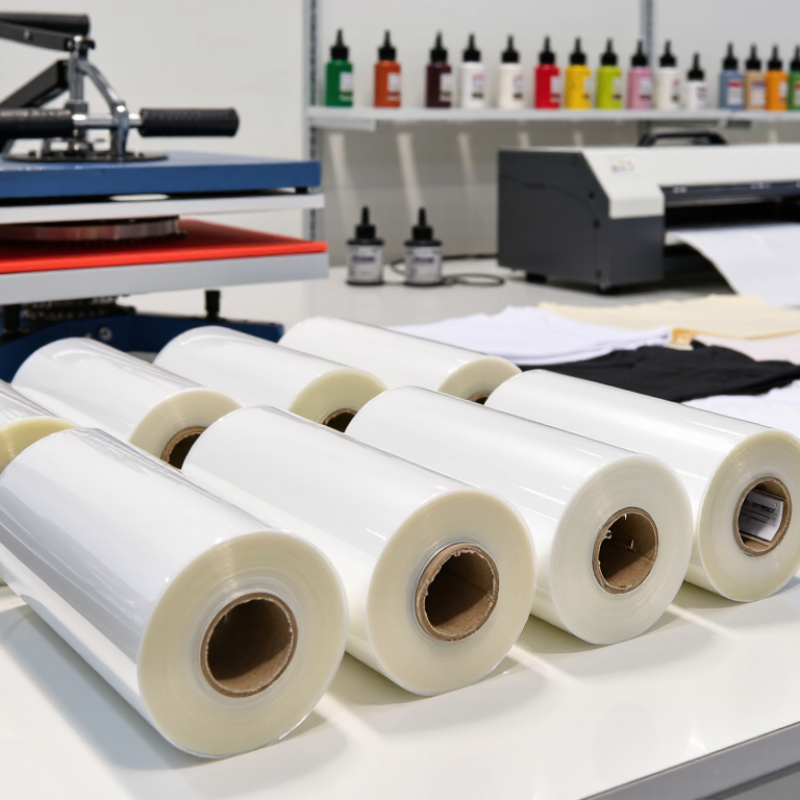
China supplies several DTF transfer film roll types for different production needs. Hot-peel film supports fast garment handling after pressing. Cold-peel film usually requires cooling before removal but may provide cleaner edges. Instant-peel film combines speed with convenient operation, although results can vary between printers and powders.

Surface finish also matters. Glossy film can create sharper color depth, while matte film reduces glare on dark garments. Single-sided coated PET film is common for standard printing. Double-sided coated film can improve feeding stability, especially on wider industrial machines. Many rolls use 75–100 micron PET, balancing flexibility and dimensional stability. Anti-static options help reduce dust and powder movement.

Quality checks remain essential. Test white-ink opacity, powder adhesion, stretching, and washing durability before purchasing large rolls. A 30-meter trial can reveal curling or uneven release. It is not perfect, but it prevents expensive surprises. Grand View Research valued the global digital textile printing market at about USD 2.72 billion in 2023 and projects a 12.1% CAGR from 2024 to 2030. Smithers also reports strong growth in digital textile applications, driven by shorter runs and customization. These figures support rising demand, but they do not guarantee every Chinese film performs equally. Use technical samples, documented specifications, and repeat-wash testing.

What Are the Best DTF Transfer Film Rolls from China?

Common DTF transfer film rolls from China are available in hot-peel, cold-peel, instant-peel, matte, and glossy finishes. Roll widths are selected according to printer format and production volume.

The chart compares nominal widths commonly offered for DTF transfer film rolls: 30 cm, 33 cm, 43 cm, and 60 cm. These sizes are suitable for different printer formats, from compact desktop systems to wider commercial equipment. Actual roll length, coating, peel method, and recommended temperature depend on the film specification.

Key Features That Define High-Quality DTF Film Rolls

What Are the Best DTF Transfer Film Rolls from China?

Key Features That Define High-Quality DTF Film Rolls

High-quality DTF film starts with a stable coating, not a glossy appearance. During production checks, I look for even powder adhesion across the full roll width. Uneven coating can leave pale edges, pinholes, or weak transfers. A reliable film should release cleanly after proper pressing. No tearing. No stubborn residue.

Film thickness also matters. Rolls around 75 microns often provide a practical balance between handling strength and transfer flexibility. The surface should resist excessive static, especially in dry workshops. Static attracts dust and can disturb fine lettering. I also check color density under ordinary lighting. Bright white ink should remain solid, while small details should stay sharp.

Storage conditions reveal another quality difference. Keep rolls sealed, dry, and away from direct sunlight. A controlled room near 20–25°C helps reduce moisture-related problems. Chinese suppliers may provide technical data, but data alone is not enough. Request a sample roll and test it on cotton, polyester, and blended fabric. Check washing durability after curing. I once trusted a smooth-looking film that produced beautiful prints but peeled after several washes. That mistake changed my inspection process. Film performance depends on ink, powder, curing, pressure, and fabric together. A strong roll helps, but it cannot correct every setting error.

How to Compare Chinese DTF Film Roll Manufacturers

What Are the Best DTF Transfer Film Rolls from China?

Comparing Chinese DTF film roll manufacturers requires more than checking price lists. Request sample rolls with the same artwork, ink, powder, curing temperature, and pressing time. Then compare color density, white ink coverage, powder adhesion, and peel behavior. A reliable film should release cleanly without lifting fine lettering or leaving a cloudy surface.

Ask each manufacturer for coating thickness, roll width tolerance, storage conditions, and recommended curing settings. Check whether every batch receives documented quality inspection. Photos are useful, but test records are stronger evidence. Examine the roll edges, core strength, winding tension, and packaging after transport. Loose winding can create wrinkles before the film reaches your printer.

Communication also matters. Ask how the factory handles coating defects, delayed shipments, and replacement claims. A manufacturer that answers technical questions clearly usually understands its process. However, do not trust polished samples alone. I have seen attractive test sheets hide uneven coating across a longer roll. That mistake can waste hours and garments. Repeating the test with three production batches gives a more honest picture. A small cost difference may be acceptable when consistency, traceability, and responsive support are stronger.

What Are the Best DTF Transfer Film Rolls from China? — How to Compare Chinese DTF Film Roll Manufacturers
Comparison Dimension What to Check Common Commercial Range Preferred Benchmark Why It Matters Evidence to Request from a Manufacturer
Film Material Base polymer used for the transfer film PET film is the standard material for DTF transfer rolls Uniform PET substrate with consistent coating PET provides dimensional stability during printing, powdering and heat pressing. Technical data sheet, substrate specification and coating description
Film Thickness Total film thickness Approximately 75–100 microns Stable thickness within the stated tolerance across the entire roll Thickness affects handling, release behavior, heat transfer and finished-hand feel. Micrometer test report from several points across the roll
Available Widths Compatibility with printer and cutting workflow Common widths include 30 cm, 33 cm, 38 cm, 43 cm, 60 cm and 63.5 cm Width matched to the actual printhead and media path Correct width reduces edge waste, skewing and printer-feed problems. Finished width tolerance and roll-width inspection records
Roll Length Usable length per roll Often 50–100 m for smaller rolls and 100–200 m for production rolls Declared length with minimal unusable leader and tail material Accurate length improves production planning and cost-per-print calculations. Net-length measurement method and packaging specification
Surface Finish Matte, semi-matte or glossy surface Matte and semi-matte finishes are widely used for DTF printing Uniform matte surface without coating streaks or shiny patches A consistent surface helps control ink absorption, powder adhesion and final appearance. Surface-finish sample and inspection images under controlled lighting
Peel Type Hot peel, warm peel or cold peel behavior All three types are available; the required type depends on the adhesive and workflow Release behavior that matches the recommended pressing process Incorrect peel timing can cause lifting, edge distortion or reduced wash durability. Recommended peel temperature, dwell time and customer test results
Printing Temperature Temperature tolerance during printing and curing Usually compatible with standard DTF curing processes around 120–160°C No visible deformation, shrinkage or coating damage within the specified range Thermal stability supports repeatable curing and reduces registration problems. Temperature range, shrinkage test and curing-process instructions
Powder Adhesion Ability of the adhesive powder to remain on printed areas Should provide clean adhesion on wet ink without excessive powder sticking to clear areas Sharp powder boundaries and minimal background contamination Good powder control improves image clarity and reduces waste or garment staining. Printed test sheet, powdering video and recommended powder particle size
Ink Compatibility Performance with commonly used DTF pigment inks Compatibility varies according to ink formulation, print settings and humidity Stable results with the buyer’s actual ink and printer settings Film performance cannot be judged reliably without testing the complete ink-film-powder system. Compatibility list plus a sample printed with the buyer’s ink
Transfer Clarity Sharpness of fine text, gradients and small graphic details High-quality film should preserve fine lines without excessive bleeding Clean edges, smooth gradients and no pinholes in solid-color areas Clarity directly affects the perceived quality of finished apparel. Standardized fine-line, gradient and solid-fill transfer samples
Dimensional Stability Change in length or width during printing and curing Low shrinkage is expected; exact limits depend on film construction Consistent registration from the beginning to the end of the roll Low dimensional change is important for continuous printing and multi-color detail. Before-and-after measurement data from a heated production test
Release Performance Ease and cleanliness of film removal after pressing Release should be smooth without pulling ink or adhesive from the garment No lifting, cracking or visible film residue after the recommended peel Poor release performance increases rejects and slows production. Wash-test images, peel instructions and sample transfer evaluation
Wash Durability Resistance to cracking, peeling and color loss after washing Performance depends on ink, powder, curing, pressing and garment fabric Passes a documented wash test under the agreed test method Wash durability is a system result, so supplier claims should be verified with actual production materials. Test method, wash temperature, cycle count and photographic results
Roll Winding Core alignment, edge neatness and winding tension Rolls should be tight and even without telescoping or crushed edges Straight edges, firm winding and consistent tension throughout the roll Good winding reduces media jams, wrinkles and feeding errors. Close-up photos of roll edges and inspection criteria for winding defects
Defect Control Frequency of coating marks, pinholes, wrinkles and contamination Defect limits should be agreed before production Documented inspection standard with traceable batch records Clear acceptance criteria prevent disputes and make supplier quality comparable. Quality-control plan, defect classification and batch inspection report
Storage Conditions Protection from humidity, heat, dust and direct sunlight Clean, dry and temperature-controlled storage is recommended Sealed moisture-resistant packaging with handling instructions Improper storage can affect coating, powder adhesion and release performance. Storage range, shelf-life statement and packaging photographs
Packaging Protection of roll edges and surface during transport Individual wrapping with protective end caps and a rigid outer carton is common No crushed edges, moisture damage or telescoping after delivery Packaging quality protects the film before it reaches the printer. Packaging specification, carton strength details and shipping photos
Sample Policy Availability of trial rolls or cut-sheet samples Samples are commonly available before bulk production Sample produced from the same coating and production line as the quoted batch A production-representative sample gives a more reliable purchasing decision. Sample batch number and confirmation of production-line consistency
Order Flexibility Minimum order quantity, custom width and private packaging options Requirements vary by width, coating, packaging and production schedule Clear MOQ, lead time and customization conditions before payment Transparent commercial terms reduce hidden costs and supply interruptions. Formal quotation listing specifications, tolerances, MOQ and delivery terms
Supplier Selection Priority Overall balance of technical performance, consistency and service Lowest price alone is not a reliable quality indicator Passes sample testing, documents quality controls and maintains batch consistency The most suitable manufacturer is the one that performs reliably with the buyer’s complete DTF process. Approved sample, signed specification sheet and pre-shipment inspection plan

Note: The ranges above are common industry reference points rather than guarantees for every Chinese manufacturer. Final selection should be based on samples tested with the buyer’s printer, ink, powder, heat press and garment fabric.

Printing and Application Factors for Choosing the Right Film

The DTF printing market reached an estimated USD 2.56 billion in 2023, according to Grand View Research. Its projected 14.4% annual growth increases pressure on film quality. Choosing the right roll now requires more than comparing price per meter. PET thickness, coating uniformity, release behavior, and roll stability directly affect production results.

A practical film usually measures 75–100 microns and should remain flat during printing. A smooth coating helps white ink form an even layer. Poor absorption can create pinholes, while excessive absorption weakens color density. Hot-peel films suit fast workflows, but cold-peel films may reduce lifting on detailed graphics. Test both on cotton, polyester, and blended fabric. Small differences matter.

Humidity is often underestimated. Store rolls in sealed packaging, away from heat, dust, and direct sunlight. Before production, print a test sheet and inspect fine text, powder coverage, edge sharpness, and peel resistance. AATCC TM61 wash testing can help evaluate durability, while repeated press tests reveal cracking after stretching. Smithers’ digital textile printing research identifies productivity and shorter runs as major market drivers. That sounds efficient, but higher speed exposes weak film faster. I have seen attractive transfers fail because the film released unevenly at the corners. Measure actual waste, not just successful samples.

Quality Checks, Pricing, and Import Considerations

Choosing DTF transfer film rolls from China requires more than comparing online prices.

Grand View Research estimated the global DTF printing market at USD 2.56 billion in 2023, with a projected 10.3% CAGR from 2024 to 2030. This growth attracts many suppliers, but quality still varies.

Request samples from different production lots. Check film thickness, coating uniformity, powder adhesion, release after pressing, and color accuracy. A practical range is often 75–100 microns, but the correct specification depends on the printer and garment fabric.

Test each roll at your real press temperature, pressure, and curing time.

Inspect the edges after washing, not only immediately after pressing. The AATCC 61 washing method can support repeatable durability testing. Small defects matter.

Pinholes may appear only under bright light. I would also record humidity, because static and moisture can affect feeding and powder coverage.

My own checklist would still need improvement; one successful sample cannot prove stable mass production.

Pricing should include film, printing, curing, packaging, inland delivery, freight, insurance, duties, and broker fees.

A low factory quote may become expensive after import charges. The World Bank’s Logistics Performance Index 2023 shows that customs and shipment reliability remain important supply-chain variables.

Ask for a commercial invoice, packing list, material specifications, and country-of-origin information. Confirm the agreed Incoterm and roll dimensions in writing.

Start with a small shipment. It may cost more per roll, but it limits inventory risk when quality changes unexpectedly.

Submit a quote request or book a design consultation

Plastimold Products is an end-to-end product development and manufacturing team.  We provide product design, engineering, prototyping, tooling, plastic injection molding, assembly, packaging and fulfillment.  We work with any size company from start-ups to enterprises from all around the world.

I have a product I want to manufacture

I have a product that is already designed and now needs to be manufactured. 

I need a manufacturer to optimize my product for injection molding, help choose the correct material, and manage the product production.

I have tooling that I want to transfer or modify, or I need to produce new tooling.

I need design and engineering support

I have a product concept that I want to be designed and brought to market.

I have a product that needs to be reviewed, improved or DFM’ed.

I am looking for a manufacturer to provide an end-to-end solution, from design and development to inventory, marketing, and sales.
