
7 Best Bath Towel Making Machines for Global Buyers
Choosing a Bath Towel Making Machine is not simply a purchase decision. It affects absorbency, softness, production speed, energy use, and long-term operating costs. Global buyers must examine the entire production line, not only the machine’s advertised output. Yarn quality, loom stability, towel weight, cutting accuracy, and finishing performance can change the final product dramatically.
Prof. Dr.-Ing. Thomas Gries, director of the Institute for Textile Technology at RWTH Aachen University, has described textiles as “a high-tech industry.” This view matters when evaluating towel machinery. A modern Bath Towel Making Machine may include electronic jacquard control, automatic tension adjustment, servo-driven cutting, and data monitoring. These features are useful, but they are not automatically valuable for every factory. A smaller producer may need reliability and simple maintenance more than maximum automation.
Details often decide the result. Check whether the machine supports terry loops without frequent thread breaks. Ask about spare-part availability in your region. Request real production samples, not only showroom footage. Confirm power requirements, installation support, operator training, and warranty terms. One overlooked sensor can stop a line.
The best choice is rarely the most expensive model. Sometimes, a less impressive machine performs better under local working conditions. That deserves honest reflection. This guide reviews seven Bath Towel Making Machine options for global buyers, comparing their productivity, fabric quality, controls, maintenance demands, and practical value. Performance claims still require verification. Every factory has different limits.
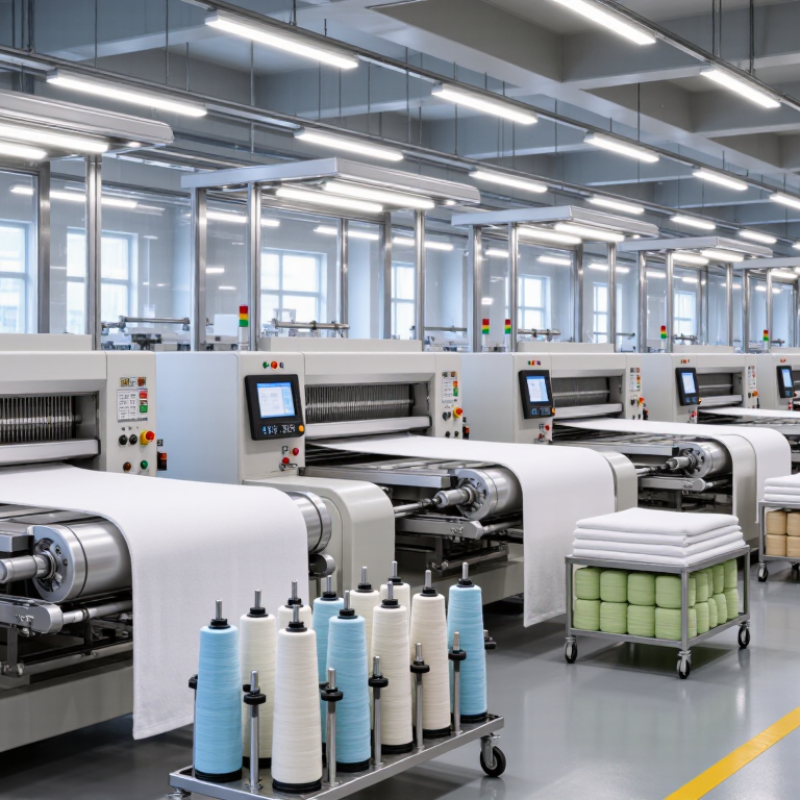
What Bath Towel Making Machines Do and How They Work
Bath towel making machines convert cotton or blended yarn into absorbent, looped fabric. A typical production line includes a warping machine, sizing machine, terry loom, dyeing machine, towel shearing machine, sewing machine, and folding machine. Each unit controls a different stage, from yarn preparation to finished packing.
The warping machine arranges yarns onto beams with even tension. Sizing adds a protective coating, reducing breakage during weaving. The terry loom then interlaces ground yarn with pile yarn, creating raised loops on the towel surface. These loops provide softness and water absorption.
A dyeing machine applies color under controlled temperature, time, and liquor ratios. Shearing trims uneven pile tops. Sewing machines reinforce hems, while folding equipment measures and stacks towels consistently.
According to Textile Exchange’s Materials Market Report 2024, global fiber production reached about 124 million tonnes in 2023. The report expects production to approach 160 million tonnes by 2030. This growth increases pressure to reduce waste, energy use, and reprocessing. Efficient machines matter.
In practice, buyers should check pile height, weaving speed, yarn compatibility, water consumption, and maintenance access. A faster loom is not always better. It may increase yarn breakage or create uneven loops.
That is a useful warning.
Modern equipment often uses sensors to monitor tension, temperature, moisture, and motor load. Operators can detect defects before an entire roll is affected. Yet automation does not remove judgment. Poor calibration, even on a new machine, can still produce rough hems, weak seams, or inconsistent absorbency.
Key Criteria for Evaluating Bath Towel Production Machines
Global buyers should judge bath towel machines by output quality, not brochure speed. Textile Exchange’s 2024 Materials Market Report estimated global fiber production at 124 million tonnes in 2023. This expanding supply increases pressure on mills to reduce waste, energy use, and rework.
Check towel weight, loop density, width accuracy, and edge stability using repeated production samples. A machine producing 40 towels per minute may still lose money if pile height varies across the roll.
Energy Performance
Energy performance deserves careful testing. The U.S. Department of Energy reports that motor-driven systems can represent more than 70% of industrial electricity consumption. Ask suppliers for measured energy use per kilogram of finished towel, not only installed motor power.
Inspect heating controls, servo efficiency, compressed-air demand, and standby consumption. These details become expensive during long shifts. Faster is not always better.
Maintenance Access and Testing
Maintenance access also separates dependable equipment from attractive equipment. Examine lubrication points, sensor locations, spare-part lead times, and cleaning procedures around lint-heavy areas. Safety functions should align with recognized requirements, including ISO 12100 risk assessment and IEC 60204-1 electrical practices.
Request factory acceptance testing with your own yarn and target GSM.
Seven Leading Bath Towel Making Machines for Global Buyers
Bath towel production depends on seven essential machine types. A yarn preparation machine controls tension before weaving begins. A rapier loom forms the towel base with stable fabric density. A dobby or jacquard loom creates borders, logos, and textured patterns. A pile-cutting machine adjusts loop height for softness and absorbency. Dyeing equipment delivers even color through controlled temperature and circulation. A towel shearing machine removes uneven fibers from the surface. Finally, an embroidery or labeling machine adds clear finishing details.
Practical factory checks show that output speed is not the only buying factor. Buyers should inspect fabric width, loop accuracy, energy use, and cleaning access. Stainless steel contact areas can support better hygiene and longer service life. Automatic tension control reduces waste, especially during long production runs. Still, every machine has limits. Some advanced systems require skilled operators and stable power. That detail is easy to underestimate.
Tips: Request sample towels before ordering. Test several yarn types. Confirm voltage, spare parts, training, and installation support. Ask for measurable data, not only attractive promises. A short trial can reveal vibration, color variation, or difficult maintenance. These small problems may become expensive later.providername
Seven Leading Bath Towel Making Machines for Global Buyers
The chart compares indicative daily processing-capacity ranges for seven machine categories commonly used in bath towel production. Actual output depends on towel size, fabric weight, machine width, operating speed, material quality, and production settings.
Comparing Machine Capacity, Features, Costs, and Applications
Choosing among the seven best bath towel making machines requires more than checking advertised speed. A terry loom can produce dense loops for hotel towels, while a high-speed air-jet loom suits large orders and lighter fabric. Rapier looms handle varied yarns reliably, but their output is usually lower. Jacquard looms create detailed borders and logos, although they require higher investment and skilled setup.
Production capacity should match your monthly demand. A compact towel weaving machine may deliver 300 to 600 kilograms daily, depending on width, yarn, and operator experience. For finishing, towel shearing machines remove uneven loops, while washing and drying systems improve softness and absorbency. Folding and packing machines save labor in retail production, but they add cost and floor-space requirements. Small factories may prefer modular equipment. Large exporters often need continuous lines.
Cost comparisons should include electricity, spare parts, maintenance, and rejected towels. A cheaper loom can become expensive when tension control is inconsistent. I have seen output estimates fall after moisture, yarn quality, and changeover time were included. That detail is easy to miss. Buyers should request tested samples, actual energy data, and service response times. Industrial machines suit high-volume hotel contracts; semi-automatic systems fit custom orders and smaller workshops. Safety guards, emergency stops, and operator training also affect long-term reliability, even when they do not increase production speed.
How to Choose the Right Bath Towel Machine for Your Factory
Choosing the right bath towel machine starts with your product specifications, not a sales ranking. Decide the towel width, GSM, loop height, and daily output before comparing the seven best options. A factory producing 450 GSM hotel towels needs different settings from one making lightweight retail towels. Machine width must match the loom and finishing line. Otherwise, fabric waste grows quickly.
Review the machine’s terry formation, speed stability, control system, and adjustment range. Experienced operators often notice uneven loops before software reports a fault. Ask for production samples using your yarn and target towel structure. Weights matter. Check electricity use, compressed-air demand, heating requirements, and noise levels during a real trial. These details affect monthly operating costs.
Global buyers should also verify documentation, safety features, local electrical compatibility, spare-part availability, and remote service response. Request maintenance schedules and clear training terms. A reliable supplier should explain limits, not promise unlimited speed. Calculate output using realistic downtime, not the brochure’s highest number. The cheapest machine can look convincing. It may still be wrong for your factory. Leave space for future orders, but avoid paying for capacity you cannot use. One practical mistake is selecting a machine before checking the finishing department’s actual bottleneck. That choice deserves another review.
7 Best Bath Towel Making Machines for Global Buyers - How to Choose the Right Bath Towel Machine for Your Factory
| Machine Type | Main Function | Typical Production Range | Suitable Towel Size or Width | Typical Power Requirement | Automation Level | Best Factory Application | Key Buying Consideration |
|---|---|---|---|---|---|---|---|
| High-Speed Terry Towel Loom | Weaves pile and ground yarns into terry fabric rolls. | Approximately 400–900 m of fabric per 24 hours, depending on width, design, and fabric density. | Common working widths of 1.9–3.4 m. | Usually about 15–35 kW per loom, excluding auxiliary equipment. | Automatic monitoring | Large-scale mills producing greige or finished terry fabric. | Check pile-height control, electronic let-off, energy efficiency, and spare-parts availability. |
| Towel Pile Warping Machine | Prepares ground and pile warp yarns for terry weaving. | Commonly handles several hundred to more than 1,000 m of warp preparation per shift, depending on configuration. | Often configured for beams used by 1.9–3.4 m looms. | Typically around 10–25 kW. | Semi-automatic to automatic | Factories operating their own weaving preparation department. | Confirm yarn tension accuracy, beam compatibility, creel capacity, and changeover time. |
| Terry Towel Dyeing Machine | Dyes cotton or blended towel fabric in rope or open-width form. | Typical batch capacity ranges from 50–500 kg, with larger systems available. | Suitable for towel fabric rolls or rope-form fabric, depending on the model. | Installed electrical load commonly ranges from 15–60 kW; steam and water demand are also significant. | Recipe-controlled | Medium and large factories requiring custom colors and repeatable shades. | Evaluate liquor ratio, water recycling, temperature control, and compatibility with reactive dyes. |
| Open-Width Towel Finishing Range | Performs washing, softening, drying, and width or shrinkage control. | Approximately 10–40 m/min, depending on fabric weight and finishing sequence. | Working widths commonly range from 1.8–3.2 m. | Electrical load often falls between 50–180 kW, with additional thermal energy required. | Continuous automatic | Integrated plants producing consistent retail-quality towel fabric. | Compare fabric overfeed control, drying efficiency, residual shrinkage, and line footprint. |
| Automatic Towel Cutting Machine | Cuts continuous towel fabric into individual towel blanks. | About 20–60 cuts per minute, depending on towel length, fabric thickness, and cutting method. | Handles common bath, hand, face, and beach towel dimensions. | Usually approximately 3–12 kW. | CNC or servo-controlled | Cutting departments serving multiple towel sizes and frequent order changes. | Look for accurate length control, low fabric waste, edge alignment, and quick size programming. |
| Towel Hemming and Sewing Machine | Overlocks or hems towel edges to prevent fraying and improve appearance. | Approximately 15–35 m/min, depending on edge construction and operator setup. | Suitable for individual towels in standard and custom dimensions. | Generally about 0.5–2.5 kW per sewing or hemming head. | Semi-automatic | Factories focused on flexible production and varied towel designs. | Assess stitch consistency, corner handling, thread trimming, operator ergonomics, and maintenance access. |
| Towel Folding, Stacking and Packing Line | Folds, counts, stacks, labels, and packages finished towels. | Commonly 10–40 pieces per minute, depending on towel dimensions and packaging format. | Can be configured for bath, hand, face, kitchen, and hotel towels. | Usually approximately 3–15 kW, plus compressed-air demand where applicable. | Automatic or integrated | High-volume exporters, hotel-linen suppliers, and retail packaging operations. | Check fold-program flexibility, counting accuracy, package-size range, and integration with conveyors. |
Article Source:
Submit a quote request or book a design consultation
Plastimold Products is an end-to-end product development and manufacturing team. We provide product design, engineering, prototyping, tooling, plastic injection molding, assembly, packaging and fulfillment. We work with any size company from start-ups to enterprises from all around the world.
I have a product I want to manufacture
I have a product that is already designed and now needs to be manufactured.
I need a manufacturer to optimize my product for injection molding, help choose the correct material, and manage the product production.
I have tooling that I want to transfer or modify, or I need to produce new tooling.
I need design and engineering support
I have a product concept that I want to be designed and brought to market.
I have a product that needs to be reviewed, improved or DFM’ed.
I am looking for a manufacturer to provide an end-to-end solution, from design and development to inventory, marketing, and sales.

©2022 Plastimold Products - Privacy policy - Terms and Conditions

