
2026 Top Pick and Place Machine Types for Global Buyers
A Place Machine is not merely a fast head moving components onto a board. It is a production decision tied to product mix, changeover time, placement accuracy, feeder capacity, service access, and the space beside the line. For global buyers, the right choice depends on what the factory builds today—and what it may need to build next year.
Demand offers useful context, but not a simple buying signal. The World Semiconductor Trade Statistics (WSTS) Spring 2024 forecast projected global semiconductor sales of $611.2 billion in 2024 and $687.4 billion in 2025. That forecast reflects an expanding electronics ecosystem, not a direct measure of pick-and-place machine demand. Buyers should treat it as background, then test machine claims against their own board designs, component sizes, and verified trial results.
Jeffrey Liker, a manufacturing expert and author of The Toyota Way, writes, “The right process will produce the right results.” Applied to placement equipment, that means comparing more than headline placements per hour. A machine may look impressive in a brochure, yet lose time during feeder changes or struggle with a changing product mix. Small details matter.
This guide compares common machine types, from flexible platforms to high-volume systems. It also considers accuracy, software, support, and total ownership costs. No single model fits every factory. Some trade-offs remain easy to miss until production starts.
How Pick and Place Machines Work in Modern Manufacturing
2026 Top Pick and Place Machine Types for Global Buyers
How Pick and Place Machines Work in Modern Manufacturing
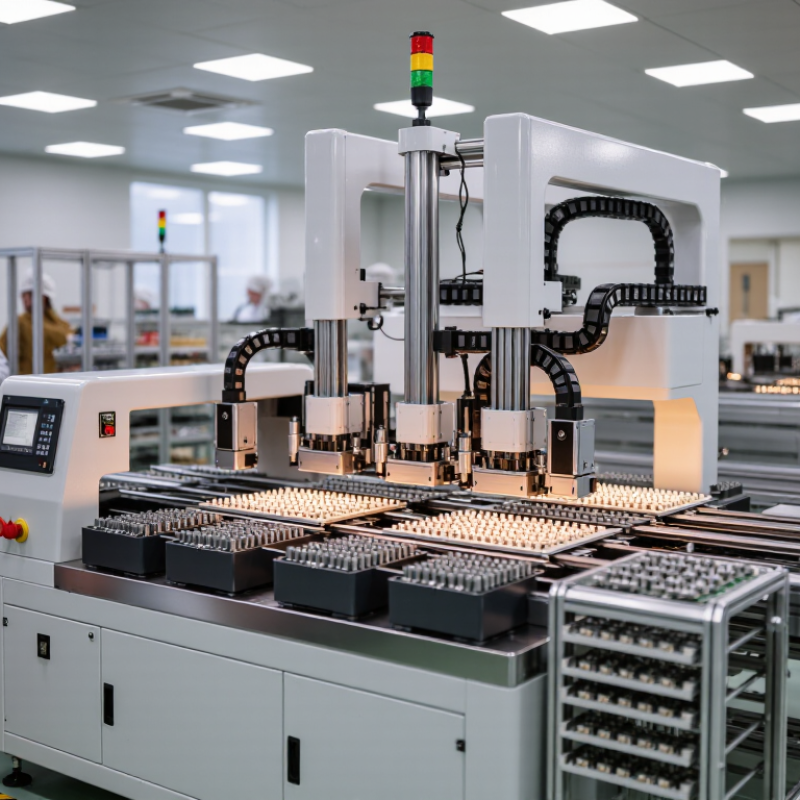
A pick and place machine positions electronic components on a circuit board before soldering. Feeders present parts on reels or trays, while a nozzle lifts each component using controlled vacuum. A camera checks its orientation and position, then the machine adjusts placement coordinates. The board moves along a conveyor and stops beneath the placement head. Small parts matter. A slightly misaligned component can affect later assembly, even when the machine appears to be running smoothly.
Tips: Keep feeders clean and correctly loaded. Check nozzle wear and vacuum levels during routine maintenance. Use a sample board to verify placement after changing components or settings. A fast cycle time is useful, but only if placement quality remains consistent.
Machine types vary in head design, feeder capacity, and supported component sizes. Buyers should compare those details with their board mix, daily volume, and changeover needs. In real production, glossy surfaces, tiny parts, or uneven solder paste can challenge vision systems. The process is precise, but not foolproof. Operators still need to review inspection results and investigate recurring errors. A practical evaluation should include a representative board, not just a machine specification sheet.
2026 Top Pick and Place Machine Types for Global Buyers – How Pick and Place Machines Work in Modern Manufacturing
Pick and place systems locate, grip, move, and release components or products. The machine type is generally selected according to the part size and shape, required motion, production volume, placement tolerance, and work-cell layout.
| Machine type | How it works | Typical configuration | Common applications | Key advantages | Buyer considerations |
|---|---|---|---|---|---|
| SMT component placement machine | Vision-guided heads pick electronic components from feeders, correct their position and orientation, and place them onto solder-pasted printed circuit boards. | Programmable placement heads, component feeders, board handling, and camera-based alignment; some production lines use separate machines for different component ranges. | Printed circuit board assembly, including consumer electronics, automotive electronics, and industrial control boards. | Designed for repeatable placement of many small components and integration into automated electronics lines. | Check supported component sizes and package types, feeder capacity, board dimensions, changeover needs, and how published placement-rate figures are measured. |
| Cartesian or gantry pick-and-place system | One or more linear axes move a pickup tool along straight, orthogonal paths, commonly across a work surface or production line. | Typically uses X-Y motion, with an optional Z axis and rotary tool axis; the frame and travel can be configured for the work area. | Machine tending, packaging, palletizing, loading and unloading, and moving parts between fixed stations. | Straightforward motion planning and a work envelope that can be adapted to the application. | Confirm travel, payload at the required reach, frame rigidity, guarding, and whether the layout needs overhead access. |
| SCARA robot | A horizontal articulated arm moves in the X-Y plane, while a vertical axis performs pick-and-place motion; a rotary axis can orient the part. | Commonly uses two horizontal rotary joints, a vertical slide, and a wrist rotation axis. | Assembly, small-part handling, packaging, and loading or unloading machines where fast planar movement is useful. | Compact footprint and efficient movement between points within its working area. | Evaluate the reachable area, vertical stroke, payload, mounting position, and whether the required paths are mainly planar. |
| Delta parallel robot | Multiple lightweight arms connect to a moving platform and coordinate to move the end effector, often from an overhead-mounted base. | Parallel-link design with a compact moving platform; vision systems and conveyor tracking may be added for sorting tasks. | High-cycle sorting, food handling, pharmaceutical packaging, and picking lightweight products from conveyors. | Low moving mass supports rapid repetitive motion in suitable applications. | Check payload, pick area, product presentation, sanitation requirements, and the need for conveyor tracking or vision guidance. |
| Six-axis articulated robot | Six coordinated rotary joints position and orient a tool in three-dimensional space, allowing the robot to approach parts from multiple directions. | Floor-, wall-, or ceiling-mounted arm with a gripper, vacuum tool, or application-specific end effector. | Machine tending, case packing, assembly, handling irregular parts, and tasks requiring varied approach angles. | Flexible reach and tool orientation for complex paths and changing work-cell layouts. | Assess payload throughout the reach, cycle time for the actual path, work-cell access, safety measures, and programming requirements. |
| Collaborative robot pick-and-place cell | A force- and safety-monitored robot arm performs programmed handling tasks and may operate near people when the complete application is risk-assessed and appropriately safeguarded. | Robot arm with a gripper or vacuum tool, often mounted on a bench, stand, or mobile base; cameras and conveyors can be integrated. | Small-batch assembly, packaging, inspection handoff, and repetitive workstation tasks. | Can suit flexible production areas and frequent task changes, depending on the application and risk assessment. | Collaborative designation alone does not make a cell safe; assess the robot, tool, workpiece, speed, layout, and applicable safety requirements together. |
| Pneumatic pick-and-place unit | Air-powered cylinders extend, retract, or rotate a pickup tool between defined positions; gripping is commonly provided by a pneumatic gripper or vacuum circuit. | Fixed-stroke linear or rotary modules, often arranged as a simple two- or three-axis transfer unit. | Dedicated assembly fixtures, repetitive transfers, and simple loading or unloading stations. | Simple point-to-point motion can be suitable for a stable task with a limited number of positions. | Check compressed-air availability, stroke adjustment, end-position control, noise, and suitability for product or recipe changes. |
Selection note: Performance depends on the complete application, including the end effector, part presentation, sensing, motion path, safety system, and line integration. Compare suppliers using the same product, cycle definition, and acceptance criteria rather than relying on headline speed figures alone.
Submit a quote request or book a design consultation
Plastimold Products is an end-to-end product development and manufacturing team. We provide product design, engineering, prototyping, tooling, plastic injection molding, assembly, packaging and fulfillment. We work with any size company from start-ups to enterprises from all around the world.
I have a product I want to manufacture
I have a product that is already designed and now needs to be manufactured.
I need a manufacturer to optimize my product for injection molding, help choose the correct material, and manage the product production.
I have tooling that I want to transfer or modify, or I need to produce new tooling.
I need design and engineering support
I have a product concept that I want to be designed and brought to market.
I have a product that needs to be reviewed, improved or DFM’ed.
I am looking for a manufacturer to provide an end-to-end solution, from design and development to inventory, marketing, and sales.

©2022 Plastimold Products - Privacy policy - Terms and Conditions